Camouflage Army Uniform Patterns Texture
Design resources come and go, but a well-executed texture collection remains a reliable tool across many projects. The Camouflage Army Uniform Patterns Texture set is one such resource. It contains 10 designer digital papers built around a classic visual language: military camouflage. At first glance, it may seem like a niche offering. In practice, the patterns in this collection serve a surprisingly wide range of design needs. Understanding what this set actually provides—and where it falls short—helps you decide whether it belongs in your asset library.
What the Collection Actually Contains
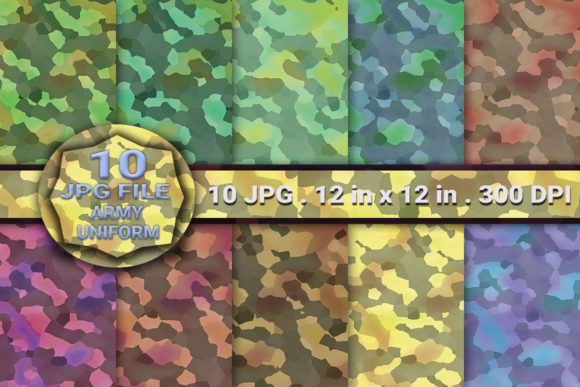
The Camouflage Army Uniform Patterns Texture collection is a zip file with 10 high-resolution JPG files. Each file measures 12 x 12 inches at 300 dpi, which translates to 3600 x 3600 pixels. That resolution is important. It means each individual tile holds enough detail for large-format printing, close-up product photography backdrops, or full-screen digital backgrounds without visible pixelation. The files are saved as JPGs, not layered PSDs or vector files, so the patterns are flattened images ready for immediate use.
Each paper in the set features a variation of camouflage patterning inspired by military uniform designs. The textures draw from classic woodland, desert, and digital camo motifs, but they are interpreted through a designer’s lens. That means the colors are sometimes adjusted, the contrast is tuned for visual balance, and the repeats are structured so the tiles can be stacked both vertically and horizontally. This seamless tiling capability is a critical feature. Many texture packs look good as single squares but fail when you try to extend them across a larger surface. Here, the patterns are built to repeat cleanly, giving you the option to create expansive backgrounds or wrapping textures without awkward seams.
Resolution and Print Readiness
At 3600 x 3600 pixels per tile, the resolution is genuinely usable. For comparison, many stock texture packs offer 2400 x 2400 pixels or lower, which limits output size. With this set, you can produce a 12-inch square print at 300 dpi directly. If you need a larger surface, tiling two or more tiles side by side maintains that same resolution across a bigger area. For web and screen use, you have more than enough detail for retina displays, hero sections, or full-screen backgrounds.
Seamless Tiling Capability
The most practical strength of the Camouflage Army Uniform Patterns Texture collection is its tiling behavior. Good tiling requires the edges of each tile to match perfectly with adjacent tiles, and the internal pattern must feel continuous rather than repetitive in an obvious way. Camouflage patterns are naturally suited to this because they lack strong focal points or straight lines that often reveal tile boundaries. The designer engineered these files so that stacking them horizontally or vertically produces a unified field. This matters for anyone wrapping a product mockup, covering a presentation slide, or building a custom wallpaper that spans several feet.
Variety Within a Consistent Theme
All 10 papers share a clear visual theme, but they are not identical. Some lean toward traditional green-and-brown woodland tones. Others use gray, tan, and muted blue variations that work better in urban or desert contexts. A few incorporate sharper digital-style pixelated camo patterns, while others use softer organic shapes. This range gives you choices without leaving the overall aesthetic. You can mix patterns from the set in a single project and maintain visual coherence as long as you stay within the camo family.
Evaluating the Quality and Usability
Texture collections are easy to create poorly. A low-effort pack might contain blurred images, inconsistent color profiles, or patterns that repeat too tightly and look like wallpaper from the 1990s. The Camouflage Army Uniform Patterns Texture collection avoids these common pitfalls. The files are sharp at full resolution. The colors are saturated without being harsh, and the contrast levels are balanced enough that text or icons placed on top remain readable with proper styling.
One limitation worth noting is the file format. JPG is a compressed format, and while these files are saved at high quality, JPG compression can introduce minor artifacts in areas of smooth gradient or subtle tone shifts. Camouflage patterns, with their irregular shapes and multiple color transitions, are somewhat forgiving in this regard, but users working at extreme magnification for large-format posters may notice faint compression patterns. For most use cases—social media graphics, printed flyers, digital backgrounds, product mockups, packaging design—the quality is more than sufficient. If your work routinely requires lossless files for massive prints, you may prefer TIFF or PNG variants. That said, the convenience of JPG and the smaller file sizes make this collection easy to work with in standard design workflows.
Another practical consideration is the resolution and 12 x 12 inch size. At 300 dpi, that is a standard printing dimension for scrapbooking, card making, and small signage. For applications like wrapping paper, fabric design, or full-wall murals, you will need to tile the images. The good news is the tiling works well. The less convenient aspect is that you must do the tiling manually in your design software. The set does not include pre-made large-format versions or vector patterns. Users comfortable with Photoshop, Illustrator, or Affinity will find the process straightforward. Novices may need a short tutorial, but the effort is minimal for the result.
Who Benefits Most From This Texture Set
This collection serves several distinct audiences. Freelance graphic designers working on branding projects for outdoor, tactical, or adventure-focused clients can pull these textures into mood boards, logo presentations, or packaging concepts. Bloggers and content creators covering topics like survival, hiking, military history, or outdoor gear will find these backgrounds useful for featured images, video thumbnails, and social media posts. The patterns provide an instant visual cue that communicates ruggedness, utility, and a no-nonsense aesthetic.
Small business owners who sell printed products such as notebooks, phone cases, fabric patches, or decals can use these textures as direct design elements. Because the tiles are seamless and high resolution, they translate well onto physical products. Marketers and publishers developing collateral for defense contractors, law enforcement training events, or outdoor recreational brands can incorporate these patterns into brochures, flyers, and trade show materials without commissioning custom photography or illustration.
Educators and serious hobbyists building visual presentations about military history, camouflage science, or pattern recognition will appreciate having a clean, printable set of reference textures. The 300 dpi resolution ensures that printed handouts or posters maintain professional quality. Even crafters who design SVG cut files or use them for card making and scrapbooking will find the 12 x 12 inch size ideal for standard craft cutting machines and paper sizes.
Possible Limitations to Consider
No resource is perfect for everyone. The Camouflage Army Uniform Patterns Texture set is not a vector collection, so you cannot infinitely scale the patterns without resolution loss. If your project demands patterns at billboard size, you will need to tile multiple files, and even then, the overall repeat width becomes finite. Also, the set is thematically focused. If you need floral, geometric, or abstract textures, this collection does not offer that. Its value is in the execution of a single theme, not in broad variety.
The JPG format, while convenient, means the images are not transparent. If you want the camo pattern on a transparent background for overlaying on photos, you will need to remove the background manually. This is a minor extra step for experienced users but worth noting for those accustomed to PNG files with pre-cut transparency.
Finally, the aesthetic is distinctly military-derived. Some audiences may associate camouflage with specific cultural or political contexts. Depending on your target market or client base, this could be either an asset or a limitation. It is worth considering the message the pattern sends before incorporating it into a design. For outdoor recreation, tactical equipment, and historical projects, it is generally a strong fit. For mainstream consumer products not related to those themes, it may feel out of place.
Final Practical Observations
The Camouflage Army Uniform Patterns Texture collection delivers exactly what its name describes: well-made, high-resolution digital papers with seamless tiling and genuine utility. The strength of this set lies not in innovation but in execution. The patterns are clean, the resolution is professional, and the tiling works as advertised. For anyone producing print or digital content that benefits from a camouflage aesthetic, this set removes the need to build those textures from scratch or settle for low-quality alternatives. It is a focused, practical resource that performs well in real-world use and offers reliable results across a range of applications. Whether you are a designer, small business owner, or content creator, these textures can save time and provide a consistent visual foundation for your work.